

Why we ran this analysis
Regulatory toxicologists rely on NHANES two-day means to model ingredient exposure, including using DaDiet to assist with Part 3 of GRAS documents.
In August 2021 NHANES moved Day 1 from the Mobile Exam Center (MEC) to a telephone interview (COVID logistics), as Day 2 has been carried out for a while.
We simply wanted to know:
Does that mode change alter mean intakes enough to matter for GRAS?
Any broader survey-method patterns you see below emerged during the analysis - they were not part of the original brief.
Methods
This might only be a quick blog post, but we still want to ensure DaDiet users of the repeatability of these results, so here's an outline of the analysis pipeline.
| Item | Setting |
|---|---|
| Cycles | 2005-2006 → 2021-2023 (2017-2020p pooled), adults ≥ 20 y |
| Interview mix | MEC Day 1 + phone Day 2 for 2005-2020; phone-phone for 2021-2023 |
| Usual-intake filter | Both days reported “about the same” as usual |
| Design | WTDR2D, SDMVSTRA, SDMVPSU; |
| Nutrient family | 31 quasi-independent nutrients chosen a-priori for GRAS work |
| Statistic | Design-based paired t (Day 1 vs Day 2) per cycle |
| Effect size | %Δ = 100 × (Day 1 − Day 2) ⁄ Day 1 |
| Multiplicity | One Benjamini–Hochberg FDR (q < 0.05) |
The decision to use only those 20 and older, and only those reporting usual consumption was inspired by Steinfeldt, L. C., Martin, C. L., Clemens, J. C., & Moshfegh, A. J. (2021). Comparing Two Days of Dietary Intake in What We Eat in America (WWEIA), NHANES, 2013–2016. Nutrients, 13(8), 2621, whose results for 2013-2016 we were able to replicate as a quality control step, although we chose a different method for reporting significance.
Results
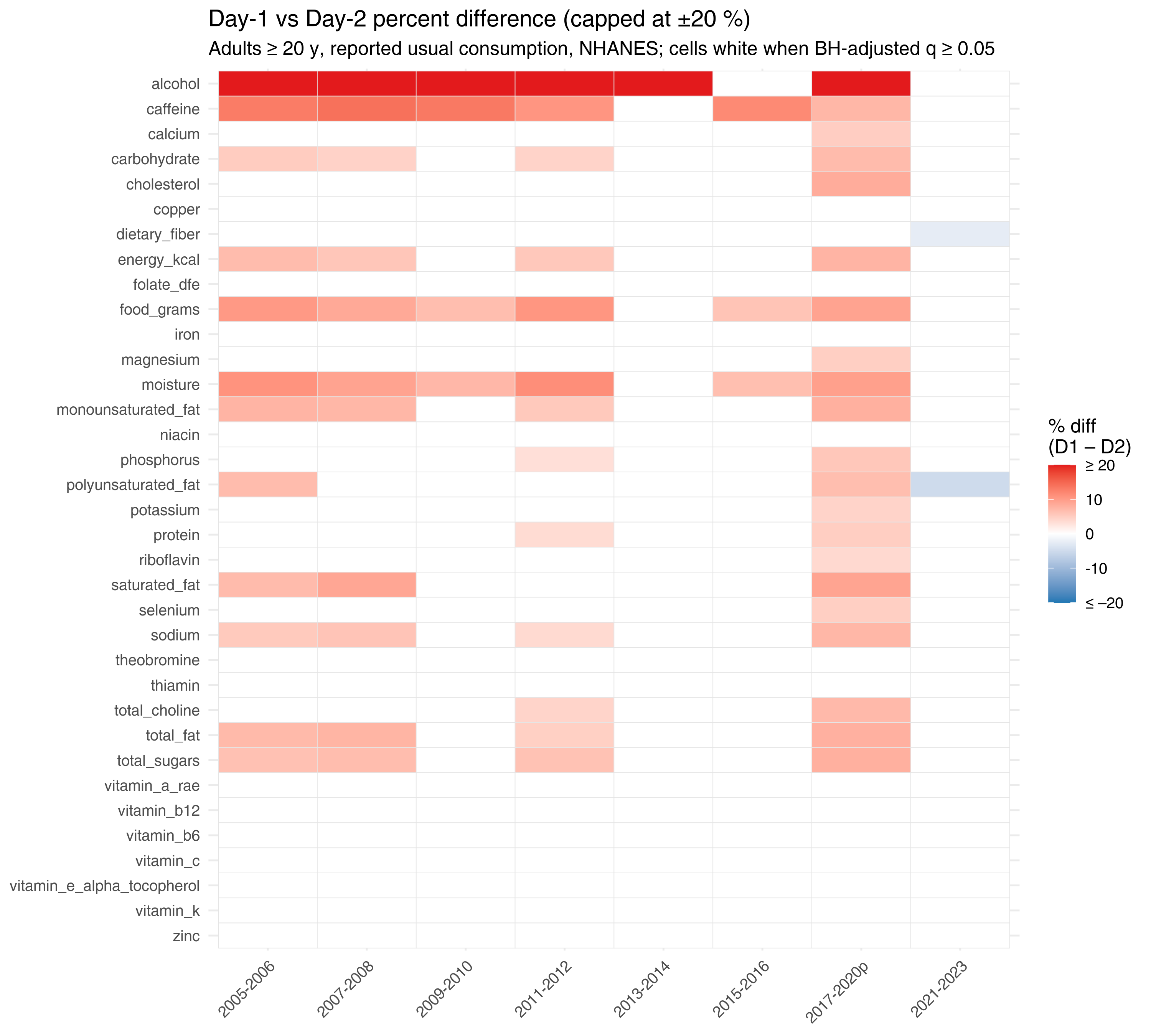
We generated the above heatmap to show the percentage reduction [in red, increase in blue] of intakes from Day 1 to Day 2 across all cycles of NHANES.
From a GRAS point of view the amount of white [no finding of significant difference after accounting for multiple testing] the results are very encouraging.
The only nutrients with significant reductions in the 2005 to 2020 cycles from Day 1 to Day 2 are alcohol, caffeine and water (moisture), possibly total sugars too. These differences largely disappear when both days have data collected via phone, mainly in the form of reduced intakes on Day 1.
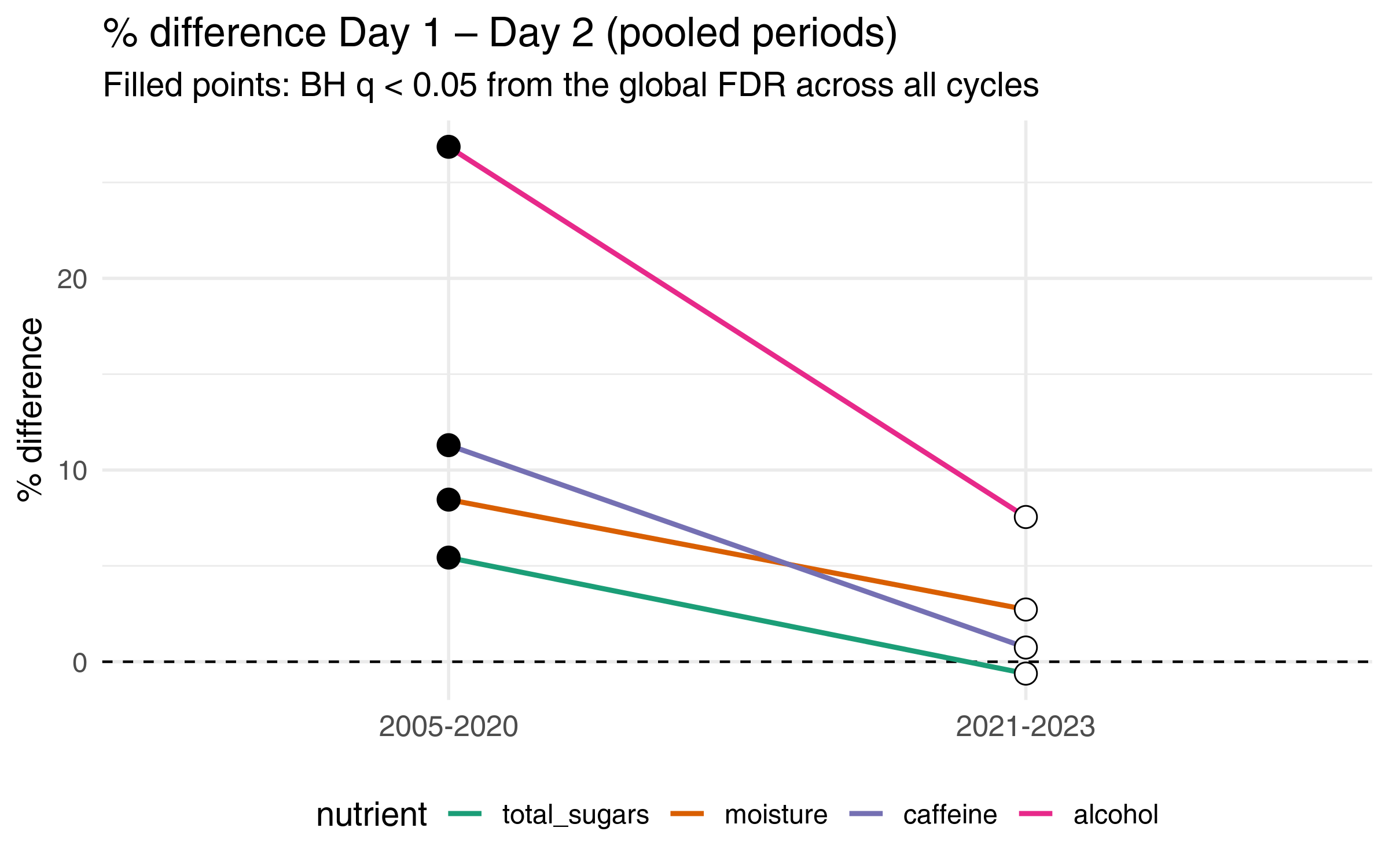
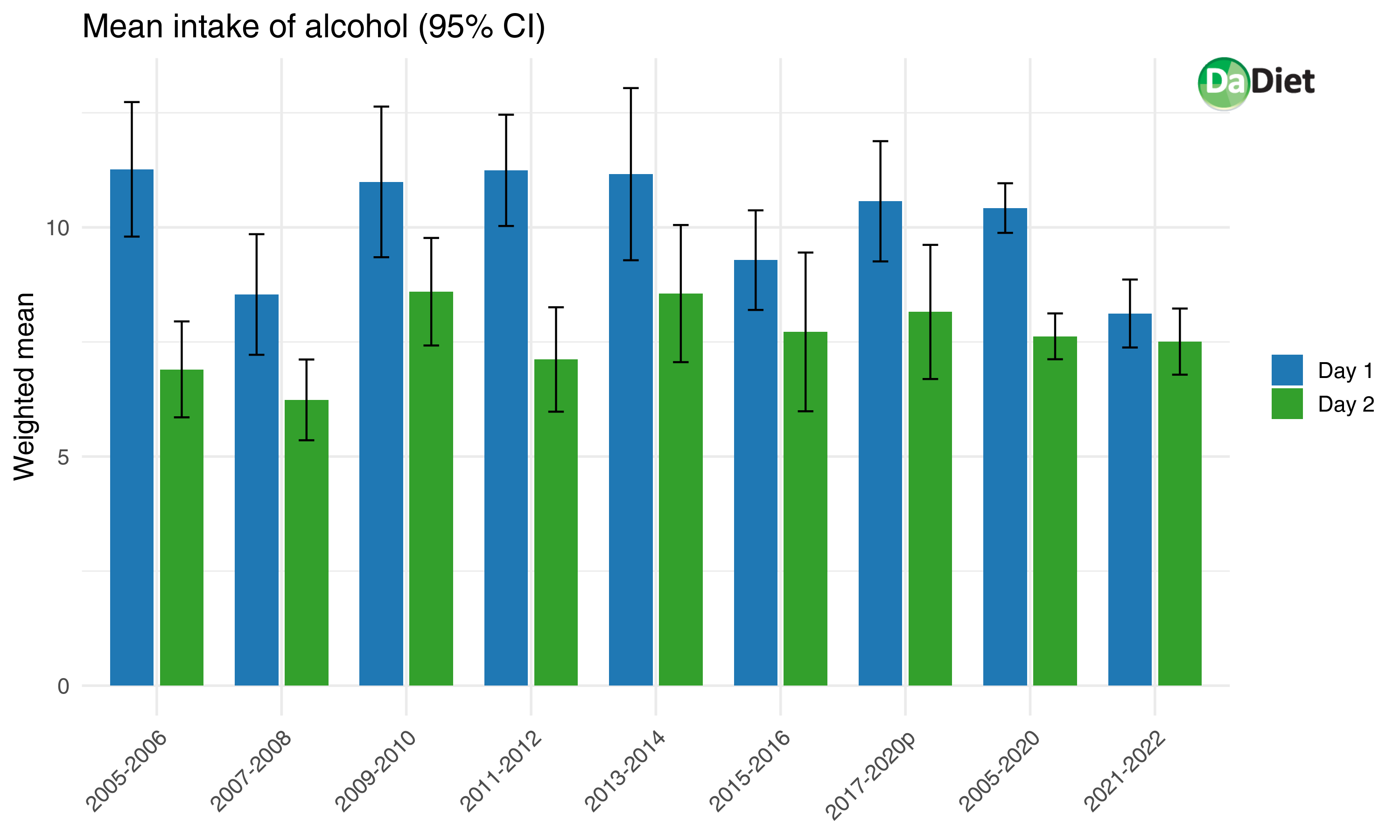
Even for alcohol the overall average reduction over 2 days is around 15% - significant if crudely interpreted from a public health nutrition point of view, but should be well covered by any reasonable margin of safety in a GRAS assessment.
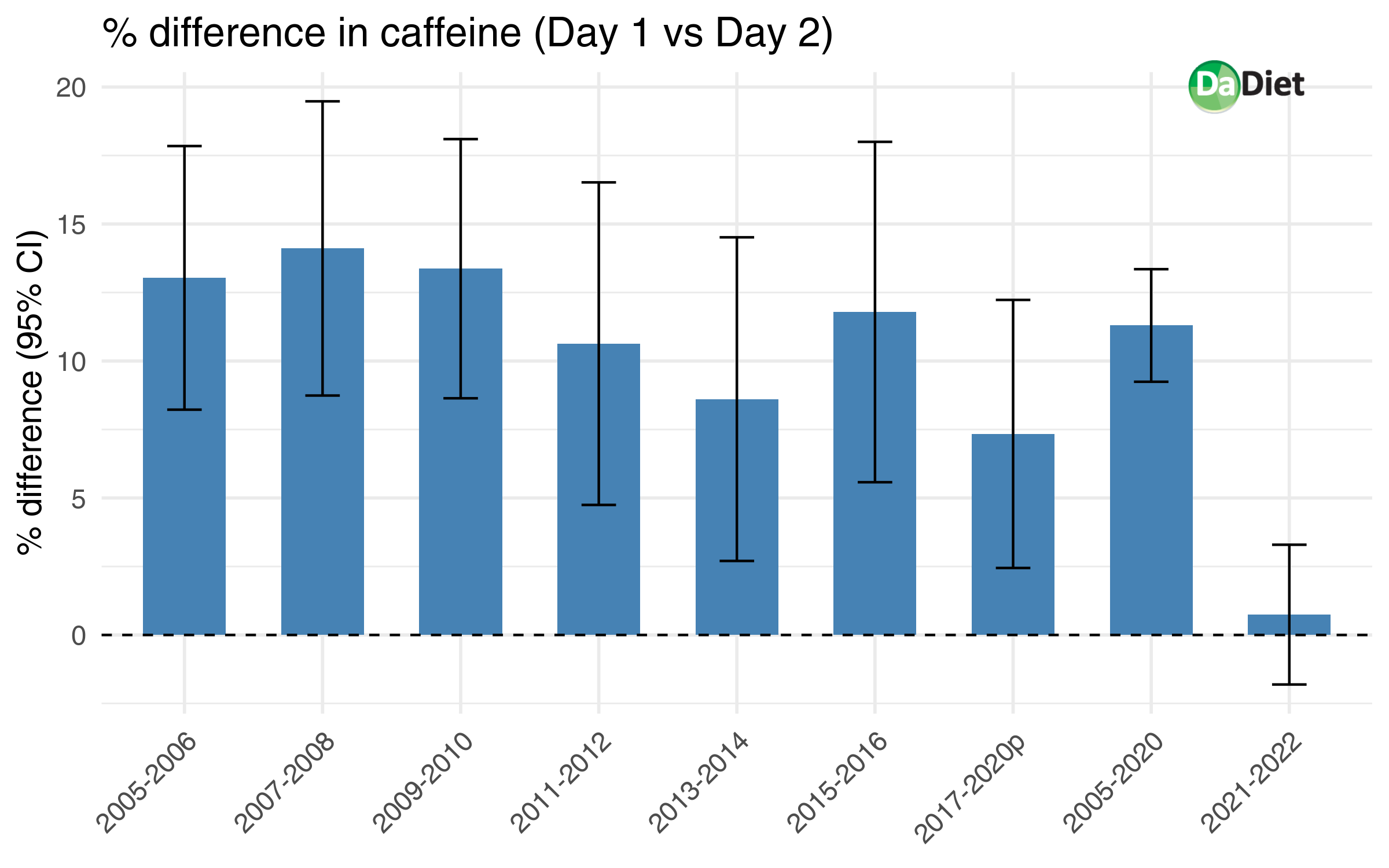
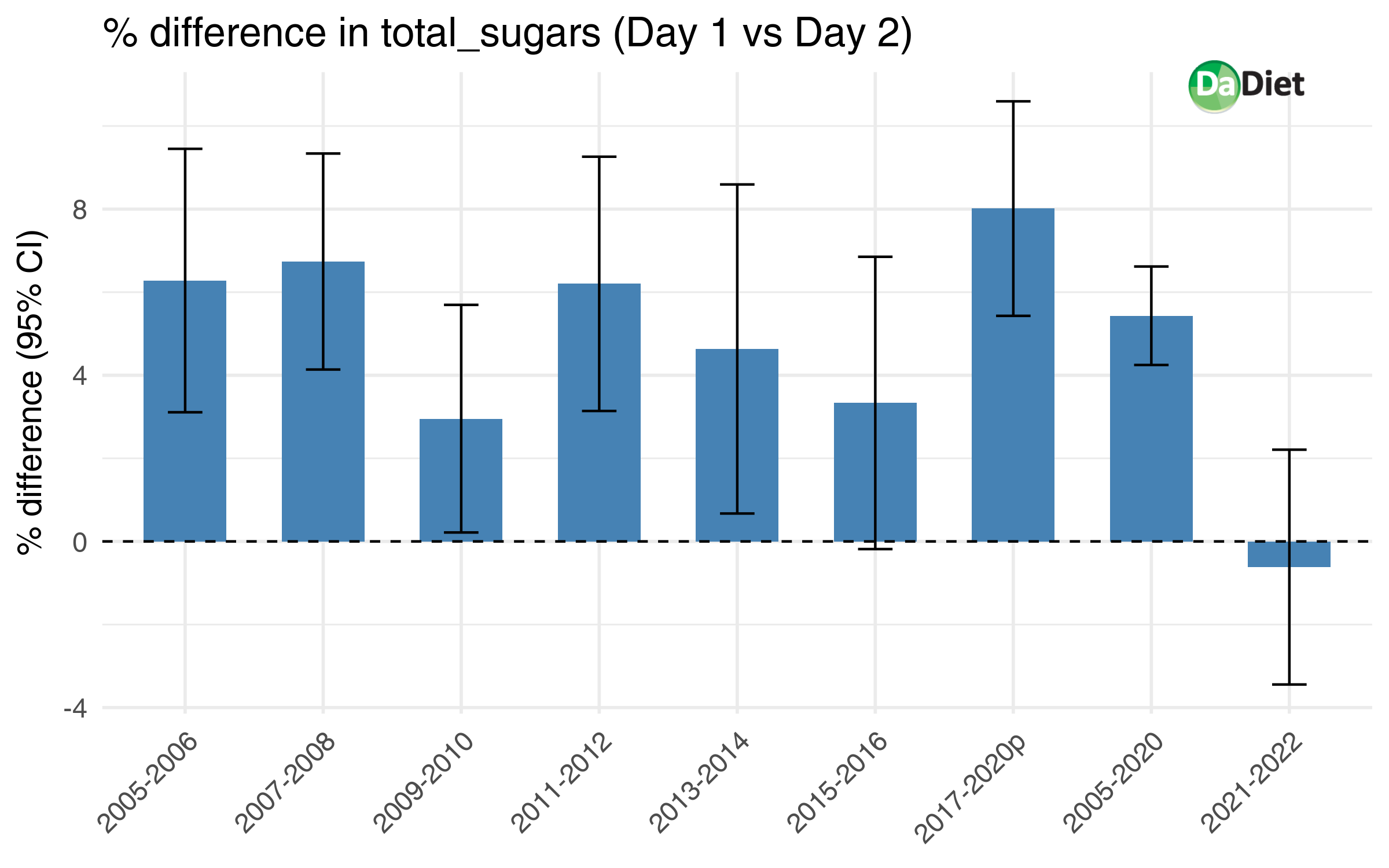
Caffeine and Total Sugar show the difference between Day 1 and Day 2 intakes disappear with the switch to two phone interviews.
This switch may provide some interesting insights for those looking to separate reporting fatigue from data collection in previous NHANES cycles.
Summary
- Aim. We asked a simple safety question: Does shifting NHANES Day-1 interviews from the Mobile Exam Center to telephone (Aug 2021 → Aug 2023) alter mean food-only intakes enough to upset GRAS exposure estimates?
- Answer. No. For the 31 quasi-independent nutrients we tested, differences between Day 1 and Day 2 are ⩽ 3 % for every solid-food nutrient including protein, fibre, cholesterol, vitamins and minerals. GRAS margins of safety swallow shifts of that size.
- The quirks. Beverage-dominated nutrients alcohol, caffeine, total sugars and plain water show 10-35 % under-reporting on Day 2 before 2021, but that bias [statistically] vanishes when Day 1 also goes phone-only. Interesting for survey methodologists; not significant for GRAS (although maybe if targeting just alcoholic drinks).
- Stats at a glance. Adults ≥ 20 y; “usual-intake” recalls only; paired design-based t; one global BH FDR (q < 0.05) across 481 tests; heat-map caps color at ± 20 %.
- Limitations. Means only (P90s and supplements will be covered in future posts); post-hoc nutrient insights; Day-of-week not controlled. Opinions expressed are personal and do not represent regulatory guidance
- Bottom line. Your GRAS dossier can use NHANES August 2021 - August 2023 with the data collection change having limited meaningful consequences.